Final draft for CK's review · not published
rai, home Book a demo

Rai Mobile Lab

Soil numbers you can act on tomorrow.

One visit, one sample, and a result the next day for the five soil values that change in days, while there's still time to act. The numbers go straight onto your plot in RaiOS, beside the satellite and the soil map. Your full laboratory report continues exactly as it does today.

  1. NO₃⁻Nitrate nitrogen
  2. NH₄⁺Ammonium nitrogen
  3. ECSalinity
  4. θMoisture
  5. °CSoil temperature

plus potassium and pH, which change over weeks

The fast five: measured in the field, reported the next day.

01 · The problem

Some soil numbers keep. Five don't.

Soil values change at very different speeds. Set that speed against how long a lab result takes and the panel divides itself. It's a question of timing, not of which nutrients matter more.

Days

Nitrate nitrogen · ammonium nitrogen · salinity · moisture · temperature

Mobile Lab, next day
Weeks

Potassium · soil pH (measuring pH in the field lets a lime application be checked within the same season)

Mobile Lab, next day
Months

Phosphorus · calcium · magnesium · sodium · sulfur · boron

Your laboratory
Years

Organic matter · aluminium · zinc, manganese, iron, copper · exchange capacity and base saturation

Your laboratory

When a value changes faster than the lab can report it, the report loses the value. So we measure the fast five in the field, and leave the rest exactly where they are.

02 · How the Mobile Lab works

We bring the lab to the plot.

Our staff measure alongside your sampling round, or your own officers do it with our instruments, calibration, software and training. Either way:

  • We own and maintain the instruments. No asset on your books; a failed probe is our cost.
  • Recalibrated every six months against certified standards, with a signed record for each unit.
  • Trained on Thai laboratory data, so the numbers improve over time rather than drift.
  • Your data, held in Thailand. You own it and can export it in full at any time.
  • It doesn't replace your lab. The slow values still go to the laboratory, and Rai reads that report too.
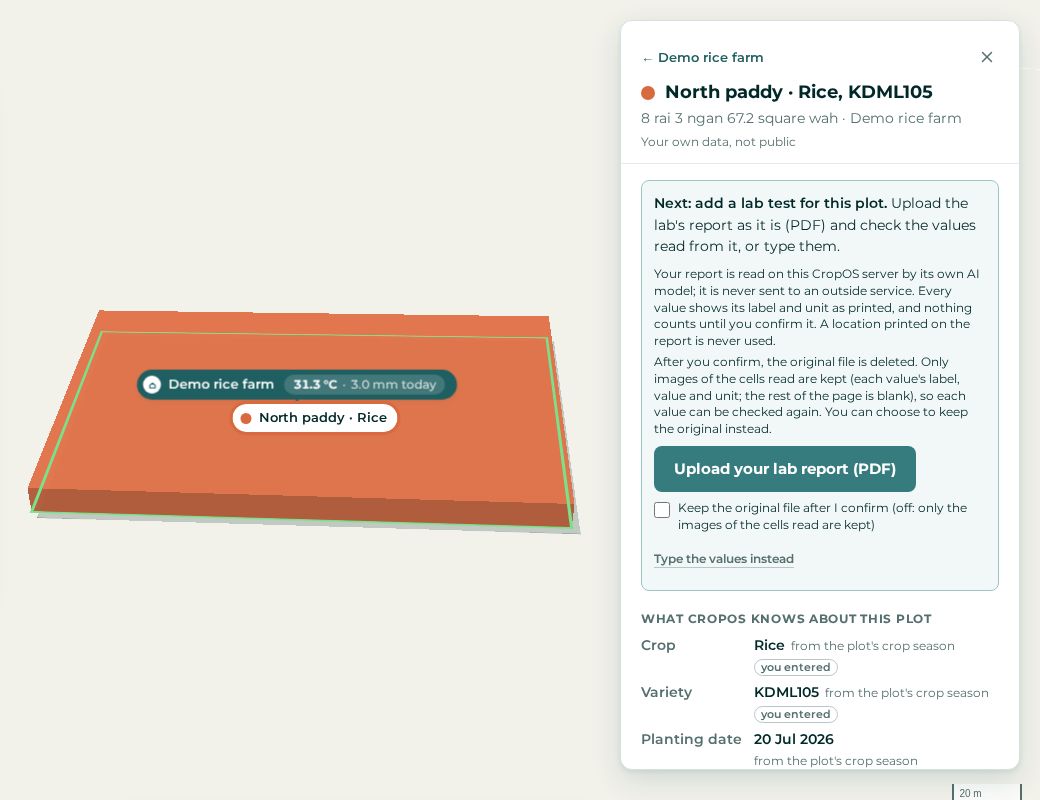
RaiOS plot panel on the farm map: next, add a lab test for this plot; upload the lab's report as it is or type the values; every value shows its label and unit, and nothing counts until you confirm it
Where the numbers land. Each plot asks for its lab test, and every value is checked by you before it counts.

03 · Calibration is the service

Why not just buy a cheap probe?

We use the same class of sensor. But in our 48-day test on six plots, a low-cost probe's nitrogen, phosphorus and potassium lines all moved in exact step with one conductivity reading (correlation 0.9999). Five layers turn that signal into a number someone can defend.

  1. 05A number the farmer can act on, corrected for the soil it came from
  2. 04Trained on paired sensor and laboratory samples from Thai soils
  3. 03Corrected for moisture, temperature and texture at that spot
  4. 02Calibrated per unit, against certified standards, every six months
  5. 01Raw signal: conductivity, moisture, temperature and pH

04 · Prove it first

Start with 90 days, and judge the numbers yourself.

Split samples from your plots across rice, maize and one vegetable crop, measured on our instrument and, in parallel, by an accredited laboratory. We publish the correlation, bias and detection limit for every value and every soil type, including where we fall short. Nothing in your present arrangement has to change.

Ask about a 90-day proof

05 · More ways we work

From one field to a whole breeding programme.

Field sensing and farm advice

Soil sensors, hubs and irrigation nodes in your fields, a weather station, and a farm chat that turns the readings into fertiliser and irrigation advice for your soil, crop and forecast.

  • Built for the farm edge. A long-range radio mesh between sensors; the hub sends by mobile network or WiFi.
  • Our Dragonfly System board speeds up communication between field sensors and RaiOS while lowering the cost of deployment.
  • Sized to the farm. Most farms need one to four crop management zones, not one sensor per rai.

Breeding and crop modelling programmes

For breeding programmes, research institutes and agencies: the breeding loop, run on your germplasm and trial data.

  1. Months 0–3Prove it on the past: link your genetic and trial data and predict results you already know.
  2. Months 3–12Predict this season's trials before harvest, with sensors on selected plots, and compare.
  3. Months 12–24Propose crosses and farm-management recipes; you plant the best. We publish jointly.
Coming

Growing high-value crops to grade

For high-value crops the price is set by grade, not by how much a farm harvests. Gourmet vanilla sells for US$180–260 a kg against US$40–80 for industrial (Madagascar export prices, 2026); cordycepin in cordyceps varies from 3 to 30 mg/g with light (Foods review, 2025). We're preparing programmes that link growing conditions to what buyers pay for, with lab checks at Thai universities.
Book a demo

Tell us about your fields.

Which crops, which provinces, and what you need to decide. We'll come back with a plan, and what we can and can't measure.

  • A short call with the people who build Rai
  • Your crop, your province, your question
  • What Rai can answer today, and where it can't yet

Or write to hello@everyrai.ai

Tell us the crop and the province if you can.

Draft form: not connected yet.
Coming soon

The crop world, open to everyone.

Explore Rai's crop world without an account, sign up yourself, and bring your own data, private unless you choose to share it. Join the waitlist and we'll tell you the day it opens.

One email when it opens. Pilot partners already use RaiOS: book a demo.